Where we started
DeepSRT's rule from day one: you shouldn't have to study a model leaderboard to watch a video. At launch in 2025 we took that further than you might remember — you didn't even provide an API key; every Gemini call was paid for by us, behind our cloud backend. One dependable choice, zero setup: that was our entire understanding of "default". Gemini carried that promise, and it remains the default today.
But the 2026 landscape has shifted. Going native put the key in your hands (BYOK), and we've watched open-weights models close the gap: free cloud models, APIs priced almost absurdly low, even models running locally on your own Mac. When "dependable" is no longer scarce, offering only one choice stops being protection and starts being a limitation. So this time the model choice moves into your hands too: you pick the provider, you pick the model id — you set your own budget cap.
In the next release, DeepSRT speaks to any OpenAI-compatible endpoint: OpenCode Zen, OpenRouter, and DeepSeek as one-tap presets; Ollama or LM Studio with a single URL. Captions and summaries choose independently — run captions on the cheap one, keep the flagship for summaries.
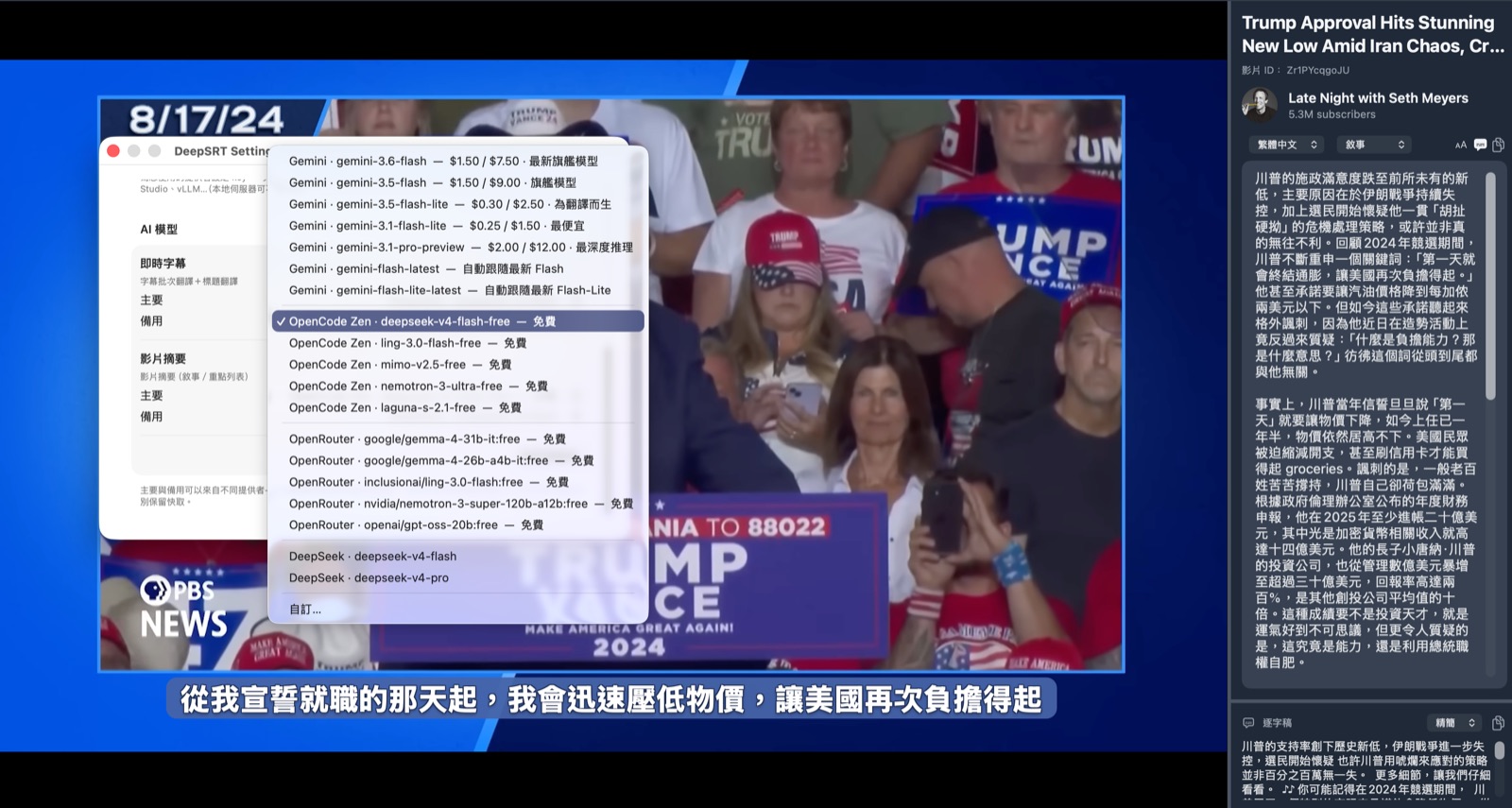
How we evaluate: speed and price — but the two tasks want opposite things
Opening up choice required us to get precise about how to choose. DeepSRT runs two AI tasks with almost opposite demands:
Live captions are a chase — you're at minute three, and that segment's translation must land within seconds. It's high-frequency, mechanical work: a 40-minute video becomes a dozen batches of twenty lines. Latency is everything; quality merely has to be good enough.
Summaries happen once per video, and you'll gladly wait ten seconds for a good one. Quality is everything; latency barely registers.
So the question was never "which model is best" — it's "which model belongs in which seat".
Thinking: the tax hidden inside latency
Testing walked us straight into a classic trap: the new generation of hybrid-reasoning models think by default. Translating a 23-token line, the model first burned 151 reasoning tokens contemplating life. Quality didn't improve — translation doesn't need philosophy — but a caption batch went from seconds to forty, and every thinking token bills at full price.
Our handling: caption batches always disable thinking (latency dropped to a tenth), summaries keep the model's default — understanding a video's narrative is worth paying for thought. This judgment is built in; pick any model and you never have to think about thinking.
Measured: DeepSeek v4-flash vs Gemini Flash-Lite
For caption translation, these are our own numbers (real 20-line batches):
| DeepSeek v4-flash | Gemini 3.5 Flash-Lite | |
|---|---|---|
| Input / 1M tokens | $0.14 | $0.30 |
| Output / 1M tokens | $0.28 | $2.50 |
| 20-line batch latency | ~3.7s | ~1–2s |
| One 40-minute video | ≈ $0.009 | ≈ $0.05 |
Caption translation is output-heavy, so the 9x output gap is what matters: roughly 6x cheaper per video. DeepSeek also auto-caches repeated prompt prefixes (our per-batch rules are identical), making cache-hit input nearly free. Gemini Flash-Lite wins on latency and steadiness — which is exactly why it stays the default.
And here's the best part of the new architecture: you don't have to choose. Primary and fallback may come from different providers — captions on DeepSeek with Gemini on standby. The moment a third party throttles or goes down, Gemini takes over and your captions never miss a beat.
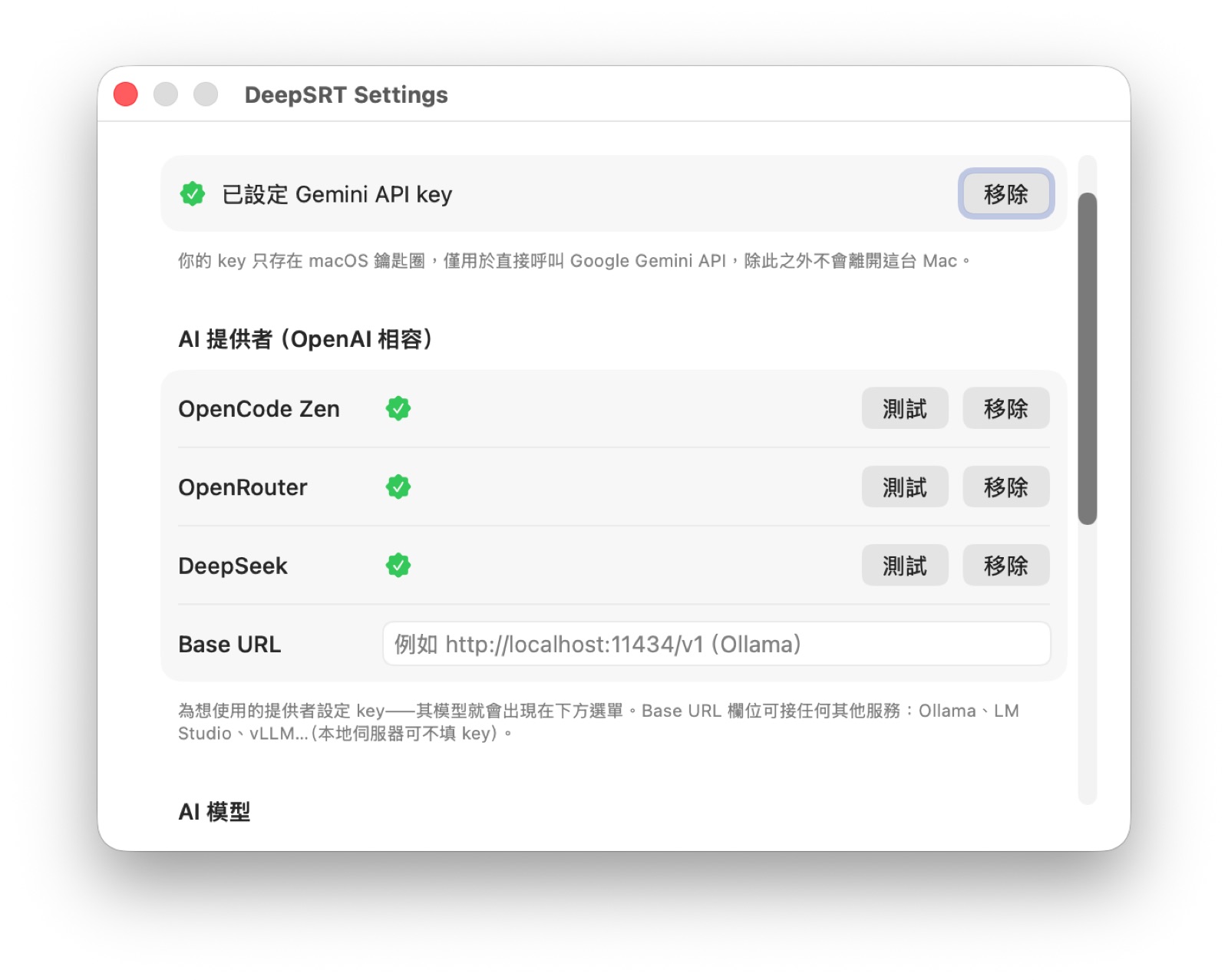
The point is choice
You might ask: doesn't this hand the leaderboard homework back to the user? No. The default is still our tuned Gemini pairing — touch nothing and the experience is exactly today's.
But if you want cheap — the free models cost nothing at all. If you want fast — stay on Gemini. If you want privacy taken to its logical end — Ollama keeps every word on your Mac, invisible even to a model vendor. The budget ceiling is yours to draw: from $0 a month to whatever quality is worth to you.
DeepSRT has no servers, takes no cut of your API spend, and now binds you to no model. What we sell was never a ticket to some model — it's the pair of hands that assembles all of this, tunes it, and keeps maintaining it. The endpoint doesn't matter; the choice is yours. This is BYOK, completed.